Friday, July 26, 2013

6 ways to do Ladakh

Isn't it amazing how some destinations can be visited over and over again and still manage to offer the most exhilarating, yet an altogether different experience each and every time?!

Ladakh is one of them. It’s the most fascinating and intriguing destination in my view and therefore figures six times on my bucket list.


What can I say about Ladakh that hasn't been said, written, or spoken about before? Not much. So I’ll dispense with the adjectives for now and list down six different ways in which Ladakh can be experienced.

a)      Do a road trip
Seeing Ladakh by road is an experience in itself. There are two ways to do this – from Kashmir Valley via Kargil and from Manali to Leh. The wonder of these two roads is that each one will offer not just a different landscape but also conjure a different emotion within you.     

The route from Kargil remains open for traffic from early June to November. The most fascinating part of this road journey is passing the Zoji-La that stands at 11,500 feet and serves as the gateway to Ladakh.

The Manali-Leh road is open for traffic from around mid-June to early October. A bus journey will take you around 19 hours (or two days) with an overnight halt in camps in between. 

See this National Geographic documentary on crossing the Khardung la to Nubra Valley by road titled ‘Perilous Journey Crossing the Himalayas.’ It does get a bit monotonous at times but the host Marsh Mokhtari will keep you engaged – sometimes with the information and sometimes with his good looks!

b)      Raft down Zanskar
A rafting expedition on the Zanskar river – a tributary of the great river Indus – is one of the most surreal experiences you will ever have. It will take you down an extremely desolate, remote and sheer Zanskar gorge with walls rising a few thousand feet from the river bed.

You can also do a rafting expedition on the Indus.

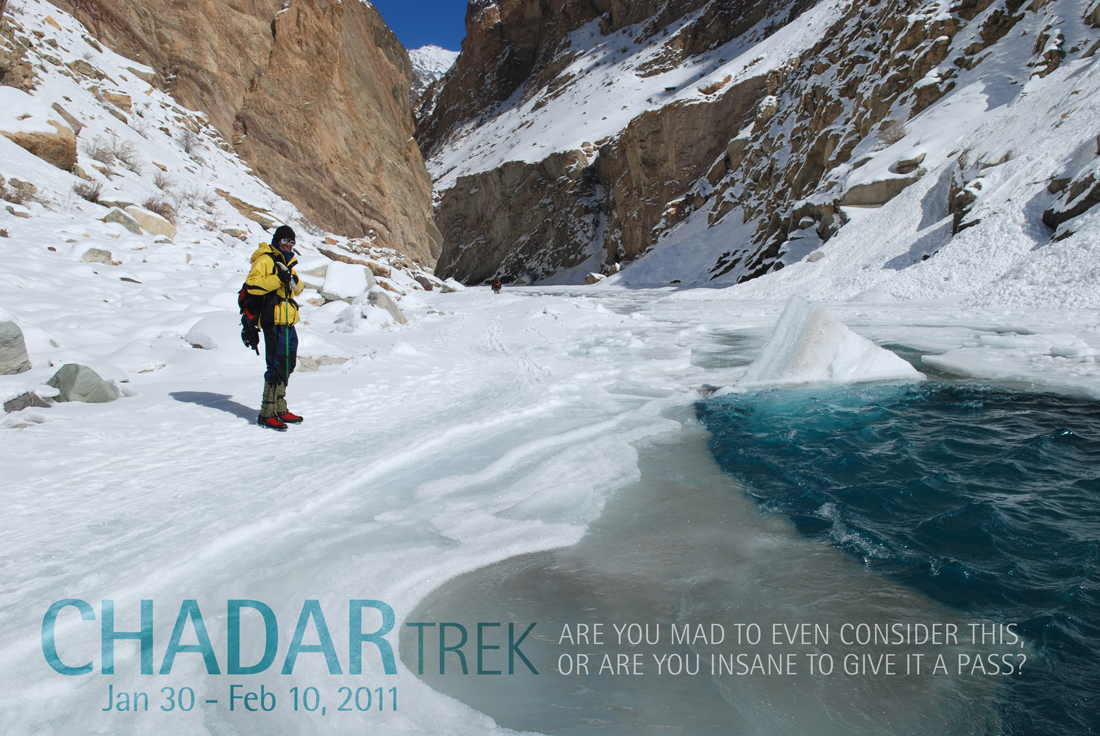
d)      Walk down Zanskar! (Chadar Trek)
The Chadar trek is taking the same route as rafting but instead of paddling in a raft, you will be walking on crampons. Here, you will experience Ladakh at its harshest. Temperatures plummeting to -25 degree Celcius with no basic amenities and absolutely no connection to the outside world until you reach Leh! Read my (rather incomplete) post on the Chadar trek for more.

c)       Trek
There are so many trekking routes in this region, that you can do 10 trips just trekking all of them. The one that tops my list is the Stok Kangri trek. It will take you to India's highest trekable summit at 20,086 feet!

The terrain and the altitude make it a very difficult trek. The Stok Kangri base camp lies at 16,300 feet and is a collage of colourful tents. Check this site for more details on the trek; it has dedicated itself to it.

e)      See the sights
You can do the usual sightseeing routine and still never get bored in Ladakh. Visit the Thicksey and the Hemis monasteries as well as the Shanti Stupa. Dare to wet your feet in the Pangong lake. Shop at the Leh market (but beware, the summer rates are high). Taste the awesome local dishes of momos and thukpa.

f)      Attend the festivals
Ladakh is extremely popular for its annual festivals. The most famous of them all is the Hemis festival that takes place every June. There is also the Thiksey Gustor (Gustor literally means ‘sacrifice of the 29th date’), which is a two-day festival and marks the victory of good over evil. It takes place at the different monasteries of Spituk, Thiksey and Karsha Zanskar in different months of the year. 

I found this site on Ladakh very informative. You can try it too.

Sunday, July 21, 2013

Chitti-chitti Bangkok

I had arranged to meet my local contact on the day I was to land in Bangkok. When he came to pick me up at SuvarnabhumiAirport, I realized that he was of Indian origin. Fifteen minutes into the conversation, I gathered to both our astonishment that we were from the same neighbourhood back in Mumbai!


Bangkok is a city where Mumbaikars will easily feel at home. The vibe (read chaos), its people, its public transport, its roads – everything reflects the life as we know it back home.

It’s also a very easy city to live in. I met (and saw) so many Indians living there and running successful businesses, most of which are into precious and semi precious stones since Bangkok has a huge market for this.

As a tourist, i loved it. Bangkok was recently rated as the number one destination for international visitor arrivals this year according to the MasterCardGlobal Destination Cities Index, managing to surpass even London by a slim margin! This makes Bangkok the first Asian city to figure in the top rank since the Index was launched in 2010.


And why not. I found it to be a pretty safe city (unless of course you are not too smart and venture out alone to places you’re not supposed to after dark). Any doubt I had regarding this was removed by one particular incident that occurred on my second night there.

I stayed at a pretty decent and basic hotel called Princeton Park Suites which is close to the city centre. There’s also a Carrefour close by! And since I was travelling alone, I took advantage of their oh-so-convenient motorcycle taxis instead of taking a tuk-tuk. They’re fast, cheap and absolutely thrilling! There’s no meter of course so fares are to be pre-fixed.  

I was out for dinner with some friends not too far from my hotel at this Indian dhaba-style restaurant that had ghazal nights every Friday. Unfortunately, we were there on a Friday too. Now, I’m not a big fan of Indian food when travelling abroad. But my friends insisted. And come to think of it, there is a certain kind of perverseness to go to an Indian restaurant abroad.

So when at midnight we decided to call it a night, I decided to take one of the bike taxis back to the hotel. I was told that it’d be safe what with the hotel being only 15 minutes away at that time. And so I went.


When I told my ‘biker’ my destination (I even showed him my hotel business card) he nodded aggressively, which if translated would mean ‘I know, I know’. So I hopped on and waved my friends goodbye. Soon I realized that we were on a highway that had a line of brightly lit Go-Go bars.

I gulped and asked the rider again if he knew where he was going, and he nodded again. I had not realized the extent of the language barrier that I was about to face that night. Apparently, English – or more precisely English as is spoken by Indians – is not understood that well in Bangkok.

Twenty minutes later and still on the highway, I began to wonder whether he would need to kill me before taking all my money, my card and my passport that was in my sack. Still praying like the dickens, I forced him to stop whenever we were lucky to spot a smattering of people and ask for directions. Apparently, Princeton Park Suites isn't that well-known among the locals!

After 35 minutes, it looked like we had gotten off the highway and finally nearing the city centre and my hotel. And five minutes later I was getting off the bike outside my hotel.

A motorcycle taxi
To my rider’s credit, he didn’t ask me for more than what was decided even though we had taken a major detour. He sat there smiling an apologetic smile and all I could do was pretend that I hadn’t minded the ride too much. So I paid 20 baht over and above the 50 that we had agreed upon and climbed up the stairs to my hotel. 

Note to self: Don't panic until it's time to panic. 

Sunday, June 23, 2013

Book review: 'What Men Think About Sex' by Mark Mason

This was a pretty bold title to review as part of my creative writing elective at Xavier's Institute of Communications way back in 2004. But i still managed to get a grade - and a decent one at that! 

Published in June of 2002, this wasn't a book that stood out from the crowd for its literary merits. In fact, i hadn't even heard of it until i saw it at a bookstore in Singapore. 

A momentary glance at the book’s title might suggest that it is on the lines of ‘Men are from Mars, Women are from Venus’ sort of non-fiction, written by an American who believes that a better approach to bridging the gap between the sexes is to do away with all subtlety.

But a detailed read through its 340-odd pages reveals that Mark Mason is actually a Londoner who has decided to shed the age-old ‘stiff-upper-lip’ tag. Nevertheless, the supposition about his nationality and the fact that the book is actually fictional are the only two presumptions that prove to be wrong. Mason, in this first person narrative, explains to its readers via anecdotes how preoccupied men are with sex and to what lengths they would go to, to get a piece of the action.

This is not to say that women don't. Think about sex, that is. 

‘What Men Think About Sex’ is set in London. It revolves around two colleagues - Tim and Rob - who work in an IT firm and their race to bed Clare Jordon from the company’s American office who is their common object of desire. According to the rules of this ‘race’, they have to sleep with five other unsuspecting women before the winner can ask Clare out.

The story unfolds through the eyes of 28-year old Rob. It is interesting to note that both men are a stark contrast to each other. While Tim is a heartless smooth talker who scores with women as easily as he forgets them, Rob is an emotional, levelheaded bloke with a sense of morality - not a strong one, but its there. 

He becomes the mouthpiece of Mason, who spends the first half of the novel telling us how shallow the darker sex really is. But he simultaneously comes to their rescue and defends their case by blaming their obsession with sex on their genetic and psychological make-up. Mason seems to have either misinterpreted Germaine Greere or has tried to boldly express his disapproval of feminism.
Mark Mason
Despite the fact that this topic has been written about and discussed time and again, Mason expands it further to include intricacies of the masculine brain and the things that appeal to such a temperament. For instance, he explains why paying for sex isn't such a turn-on and that sleeping with an ex isn't really a big deal for men. Of course, this calls for a lot of generalisations on Mason’s part, which he clearly states at the outset. Certainly, such liberties are excusable only if it is undertaken by a member of the same sex.

Like most first novels, this too has a tinge of autobiography. Mason tells us (through Rob, of course) that the entries that make up this 21st century pulp fiction novel are “scribblings”. And he’s right. At times, his writing does come across as amateurish and frivolous with some amount of repetition. But it also has spurts of humour interspersed with glimpses of profound reasoning as to why men behave the way they do. 

But the peg of the story - the Clare Jordon Five and Three-Quarter Feet Handicap Stakes race - is too far-fetched. And if men are really capable of devising such a contest then its better that it remain between the covers of personal diaries.

Although this novel’s perceived intention was to delve deeper into the male psyche of how men perceive sex and - in the process - how they perceive women, the end product might come across as a disappointment to its female readers. For one, in the process of explaining how men really think, Mason has objectified women as someone with whom men can only go to bed. And despite the fact that the book’s title forces Mason to stick to its main topic, which is obviously sex, he tends to overdo it in more than a few places. At every step, the reader is party to how Tim and Rob desperately attempt to bed women. This makes the entire act appear mechanical. In fact, their promiscuity eventually becomes so emphatic that love seems like an outdated idea. Thankfully, Mason spares his readers of the details of acts that follow on various occasions and allows their imagination to take over. 

Perhaps, what Tolstoy said about a woman’s beauty is true even for sex: its best description is by understatement.

Although Rob’s participation in this race pricks his conscience now and then, he gives it up only towards the end of the story when he stumbles upon the truth - what he is really seeking is a soul mate, which he finds in his ex-girlfriend, Hannah. Therefore, Mason does veer towards sentimentality and love eventually, proving that the old-fashioned and under-rated emotion isn't a completely extinct concept. In the end Rob says, “As I sat there, listening to my recorded voice and Hannah’s, ‘Purple Rain’ soaking everything we said in the perfection of a thousand memories and a million hopes, life told me that Hannah was the one.

What Men…’ obviously isn't a manual on man-woman relationships. But it is fairly successful in raising and answering many of the questions that plague the minds of most women who have tried to understand the male psyche. In that sense, the book can prove to be informative and fun with its easy language and style. British humour never fails to produce the laughs, even when it comes with a title as crude as this. 

Saturday, June 15, 2013

Book review: ‘Into Thin Air’ by Jon Krakauer

As a novice in the exciting world of mountaineering, I had overheard plenty of passionate conversations about a tragic Everest ascent and a few legendary mountaineers that the world lost that day. I was instantly intrigued.
And then one cold day while browsing through some books in a quaint little bookstore in Darjeeling that looked like it had been around since the Britishers had taken up residence there, i stumbled upon 
'Into Thin Air'.

Now, there are books that you don't give a second thought to, some that make you think days, even months, after you've read them. And then there are some that you never forget your whole life. 'Into Thin Air' falls in the last category.     

Jon Krakauer
Written in 1997, it is a first person account of the 10 May, 1996 Mount Everest ascent that took the lives of eight skilled climbers – the worst tragedy Everest has ever seen. Krakauer, a journalist and a mountaineer, wrote this book as an act of catharsis and his raw and honest description of the event is difficult to read without a lump in one's throat. It is, after all, heart-wrenching to be party to the death of so many great climbers especially after being a part of their lives, even if it is just on paper.

Krakauer’s record becomes even more moving because he was not only a part of the guided expedition but he also witnessed the death of some of his companions and even his team leader and mountaineering guide - the gregarious Rob Hall. Despite the fact that Krakauer’s memory of the final ascent was distorted by exhaustion and shock, he has tried to write as accurate a summary as possible by giving a day-to-day and even a minute-by-minute account of their treacherous climb on the unforgiving terrain of the snow-covered Himalayas at 29,028 feet. At that altitude though, time slows down dramatically!


This book easily slips into the slot of must-read books - for everyone. 
But for mountaineers it holds special reverence. It not only speaks their language but also uncovers the harsh realities of life - and death - in the isolation of 26,000 feet often referred to as ‘The Death Zone’. This account also mentions mountaineering greats like George Mallory, Andrew Irvine, Sir Edmund Hillary, and Tenzing Norgay.
 

To compress an exhilarating, life-altering experience of arriving at the apex of the planet into a few hundred pages is a daunting task. But Krakauer attempts to do that. And succeeds. He also raises important issues that need to be tackled: commercialization and competition in climbing where safety is indispensable. 
An apt read on the 60th anniversary of summiting the world's highest mountain. A must read at any time for adventurists.     

Monday, June 10, 2013

Indi-Chini, bhai bhai

India and China have so often been mentioned in the same breath – whether the conversation is about economy growth, GDP or our collective contribution to world population.

Despite having so many differences though, the Indians and the Chinese share so many similarities. Nehru was right after all.     

Take for instance, the way we are travelling. Both, the wealthy Indians and the rich Chinese are an emerging breed of globetrotters who seem to have recently discovered the joys of travelling.

But with this bullishness has also come a bit of obnoxiousness – something which we Indians have perfected over the years. Take for instance, the recent hubbub that occurred when a discerning Ding Jinhao scrawled his name followed by ‘was here’ in Chinese letters on a 3,500 year old temple wall in Luxor, Egypt.


Now we all know that making graffiti on World Heritage Sites is our forte. Hell, we invented it! The only difference is that when we were on the upward curve as China is right now, there wouldn't have been such uproar on any social media platform. That is possibly because social media hadn't taken off in India at that time. But that is beside the point.

There are certain etiquettes that we as travelers need to learn. Some years ago, I was browsing through some perfumes in the duty-free section of Frankfurt Airport. I couldn't find testers for the one I wanted so I asked the woman at the counter for it. She politely asked me to wait till she got one, throwing in “some Indians helped themselves to them before the last flight” for good measure.

Just like Shen, the embarrassed Chinese tourist who photographed the Luxor graffiti and posted it in on a microblogging site, I didn't know where to look or what to say. Hoping that a purchase would serve as an apology, I shelled out 80 euros and bought the perfume.   

The truth is – the attitude of the wealthy Chinese matches that of the wealthy Indian. Both think that money gives them a right to expect anything they want. The recent Gupta wedding scandal is a good case in point.

Often referred to as “the next China,” India in this particular instance has managed to precede its Chini bhai

Hurun Research Institute recently published a report that reveals details of the travel habits of the Chinese luxury traveller and makes for interesting reading.   

Friday, May 24, 2013

What’s your favourite?

Couple of weeks ago, TripAdvisor released the results of a survey it did with travelers across countries. It asked them what their choice of brand was for a particular product while traveling, which is always interesting to know.

In India, there were 13 winners in 14 categories ranging from lip balms to travel magazines and luggage. Personally, I would like to see many more products featuring in this survey. Like armchairs. I’m always on the look-out for a good one to travel. 


Here's what TripAdvisor found:

Luggage: American Tourister          
Travel Magazine: Lonely Planet      
Gum & Mints: Polo
Camera: Sony                              
Headphones: Sony                       
Cab Service: Meru Cabs                
SUV: Toyota Fortuner                   
Hand Sanitizer: Dettol
Tablet Computer: Apple iPad               
Sunscreen: Nivea
Outdoor Shoe: Nike
Lip Balm: Vaseline 
Packaged Snacks:Lays 
Bottled Water: Bisleri 


Anyway, some products that TripAdvisor has featured don’t make much sense. For instance, why would you need headphones when you’re traveling? The entire point of it is to absorb, and how do you do that with one of your most important senses blocked with a Sony headphone.

And packaged snack? Really?! These guys seem to have a really keen sense of travel! Whatever happened to eating local junk food?

A tablet computer would be okay, i guess, if i stretched it a bit - you know for local information and stuff (unless of course you're a travel writer and need to document). But wouldn't it be much more fun if one were to get local information from the locals? 

And who can forget! - what airline people prefer

In fact, i have often felt that even a camera comes in the way of actually soaking in the atmosphere. i'd much rather see a place through my own eyes than a lens sometimes.  

And who really needs a sunscreen when traveling, right? A good tan reflects a holiday well-spent.  

What is completely bang on though is Vaseline – and not just as a lip balm but also as a hand and body moisturizer. See my old post on the Chadar trek and you’ll know what I mean.  
What I’d also like to know is the brand of day sacks travelers prefer, and why. Mine is a really smart, black sack I bought from Nepal almost a decade ago but still in excellent condition. I love it because it is black, of unspecified brand, made of very good material, has the word ‘Everest’ inscribed on it, is soft and comfortable to carry, is of the perfect size and has two convenient net pockets on either side. Love it.


What’s your favourite item while travelling?